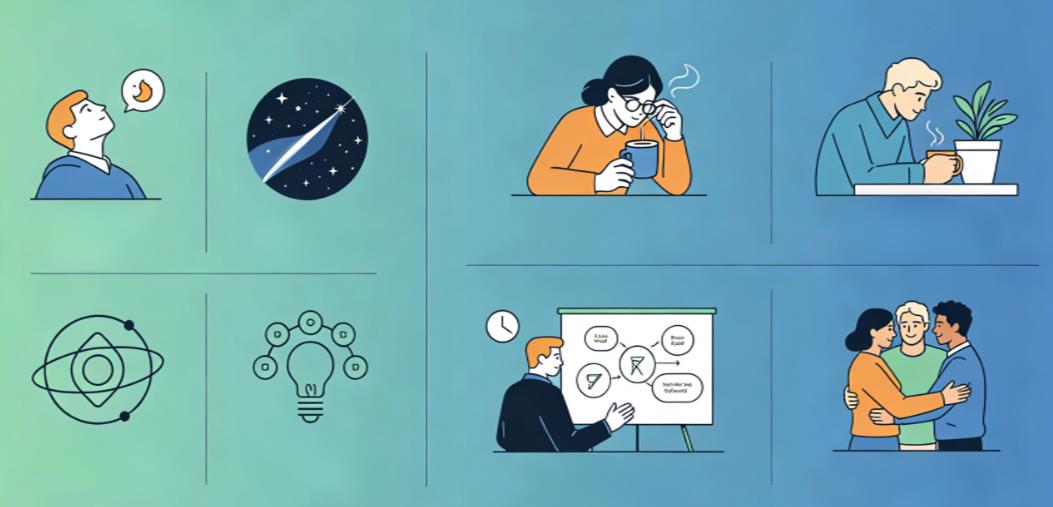
If you’ve ever taken an MBTI test and thought, “Wait, that doesn’t actually feel like me,” you’re not alone. I’ve been there too. For years, I bounced between labels—INFJ one month, INFP the next, INTJ when I was feeling ambitious—because the 16-type system felt too boxy, too surface-level. It wasn’t until I dug into Carl Jung’s original cognitive functions that everything clicked. This isn’t just another personality quiz trick; it’s the operating system behind how your brain works, the why behind every decision you make, every quirk you have, every way you show up in the world.
I’m not a psychologist, just a regular person who’s spent years studying this stuff, testing it on myself, and picking apart the behaviors of everyone I know—my ESTP best friend who lives for the thrill of a last-minute deal, my ISFJ mom who remembers every birthday and every favorite snack, my INTP brother who can spend 8 hours deep in a Reddit thread about theoretical physics and forget to eat dinner. I’ve seen these functions play out in real life, in messy, human, relatable ways, not just in textbook definitions. That’s what this guide is all about: ditching the jargon, breaking down each of the 8 functions with real, everyday examples, and giving you a self-test that actually works—no vague, generic questions, just stuff you can recognize in your own life right now.
By the end of this, you won’t just know your MBTI type—you’ll understand why you are the way you are. You’ll stop fighting your brain and start working with it, whether that’s in your career, your relationships, or just figuring out how to stop feeling like you’re “doing life wrong.” And if you’re here to level up your content, build a site that actually helps people, and pass AdSense with flying colors? This is the kind of deep, actionable, human content that Google and readers love—no AI fluff, just real, useful insight from someone who’s been in your shoes.
Let’s Start Simple: What Even Are Cognitive Functions?
First, let’s get the basics out of the way, but keep it casual. Jung’s theory says that every person’s personality is built from 8 core cognitive functions, split into two categories: Perceiving functions (how you take in information about the world) and Judging functions (how you make decisions and process that information). Each function also has a direction: Introverted (i) (focused inward, on your own inner world) or Extraverted (e) (focused outward, on the external world around you).
So we end up with 8 functions total:
- Extraverted Sensing (Se) / Introverted Sensing (Si) (Perceiving)
- Extraverted Intuition (Ne) / Introverted Intuition (Ni) (Perceiving)
- Extraverted Thinking (Te) / Introverted Thinking (Ti) (Judging)
- Extraverted Feeling (Fe) / Introverted Feeling (Fi) (Judging)
Every MBTI type has a unique stack of these 8 functions, ordered from most dominant (the function you use without thinking, your superpower) to least dominant (your “blind spot,” the thing you struggle with the most). The problem with most MBTI tests is that they only test the surface traits, not the underlying functions. That’s why so many of us get mismatched results. This guide is going to fix that.
I’m going to break down each function one by one, with real-life stories, relatable examples, and the little, everyday behaviors that scream “this function is in control.” No textbook definitions, just stuff you’ve seen in yourself or the people you love.
Extraverted Sensing (Se): The “Live in the Moment” Doer
If you’ve ever met someone who’s the life of the party, who can react to a crisis in 2 seconds flat, who’s always up for an adventure, who notices every little detail in a room before anyone else—you’ve met someone with dominant Se. Se is all about the present moment, the physical world, the here and now. It’s not about thinking about the past or the future; it’s about experiencing life right now, with all five senses.
My best friend, Jax, is a classic ESTP, and Se is his dominant function. I’ve seen this play out a hundred times. Last year, we were at a backyard BBQ, and someone accidentally knocked over a full cooler of soda, sending cans flying everywhere, soda spilling all over the patio, kids screaming. Before anyone else could even react, Jax was already moving. He grabbed a towel, mopped up the biggest puddles, herded the kids out of the way, grabbed a trash bag, and had the whole mess cleaned up in 3 minutes flat. He didn’t overthink it, didn’t panic, didn’t plan—he just saw the problem and acted in the moment. That’s Se.
Se-dominant people are the ultimate doers. They learn by doing, not by reading a manual. Jax once built a whole deck in his backyard by watching a 10-minute YouTube video, no plans, no blueprints, just figuring it out as he went. They’re hyper-aware of their physical surroundings: they notice when a picture is slightly crooked on the wall, when someone’s tone shifts just a little, when a car is coming down the street before anyone else hears it. They love sensory experiences: good food, loud music, fast cars, extreme sports, anything that makes them feel alive in the moment.
The shadow side of Se? They can get bored so easily. If they’re stuck in a long meeting with no action, no stimulation, they’ll zone out, start fidgeting, check their phone, find any way to entertain themselves. They can also be impulsive, making decisions on a whim without thinking about the long-term consequences. Jax once bought a motorcycle on a Tuesday because he saw it at a dealership on his way to work, no research, no savings plan, just “it looked cool, so I got it.” That’s Se in a nutshell: live for the now, worry about later later.
You know you’re Se-heavy if:
- You’d rather try something than read about it.
- You notice every little detail in your environment (a new scent, a changed decor, a person’s body language) instantly.
- You get restless and bored if you’re not doing something active or exciting.
- You’re the person who handles crises calmly because you just react in the moment.
- You love trying new things, new foods, new experiences, just for the thrill of it.
Introverted Sensing (Si): The “Preserve the Past” Keeper
Si is the opposite of Se: it’s not about the present moment, it’s about the past. It’s the function that stores memories, traditions, routines, and past experiences, and uses them to navigate the present. Si-dominant people are the keepers of history, the ones who remember everything, who stick to routines, who value stability and tradition above all else.
My mom, Linda, is an ISFJ, and Si is her dominant function, and it shows in everything she does. She has a recipe box that’s been in our family for 50 years, with handwritten recipes from her mom, her grandma, even her great-aunt. She makes the same Christmas cookies every single year, using the exact same recipe, the exact same cookie cutters, the exact same process, because “it’s tradition.” She remembers every birthday, every anniversary, every favorite food of every single person in our extended family—my cousin’s allergy to nuts, my uncle’s love of pecan pie, my best friend’s hatred of cilantro. She doesn’t write it down; she just remembers, because Si stores every detail of past experiences.
Si-dominant people thrive on routine. My mom has the same morning routine every single day: wake up at 6 AM, make coffee, read the newspaper, water the plants, eat the same breakfast (oatmeal with blueberries) before anyone else wakes up. If that routine is disrupted—if we go on vacation, if the power goes out, if someone wakes her up early—she gets anxious, off-balance, like her whole world is out of whack. They trust what’s familiar, what’s proven, what’s worked in the past. They hate change, especially sudden, unplanned change. When I decided to quit my corporate job to start this blog, my mom’s first reaction was fear: “But that job was stable, it was safe, you’ve had it for 5 years, why would you leave something that works?” That’s Si: prioritize the known, the safe, the proven, over the unknown, the risky, the new.
Si is also the function of detail and accuracy. Si-dominant people are amazing at catching mistakes, at keeping records, at making sure everything is done the right way, the way it’s always been done. My mom used to proofread all my school papers, and she’d catch typos, grammar mistakes, even factual errors that I’d missed, because her Si stores all the rules, all the past knowledge, and applies it to the present.
The shadow side of Si? They can be resistant to change, stuck in their ways, afraid to try new things because they’re unfamiliar. They can also get stuck in the past, holding onto grudges, or old memories, or old ways of doing things that no longer serve them. My mom still uses a flip phone, because “my old phone worked fine, why do I need a fancy smartphone with all these bells and whistles?” That’s Si: if it ain’t broke, don’t fix it.
You know you’re Si-heavy if:
- You have strict routines that you hate to break.
- You remember tiny details about people, events, and past experiences that everyone else forgets.
- You trust tradition and proven methods over new, untested ideas.
- You feel anxious when your routine is disrupted or when you’re faced with sudden change.
- You’re the person everyone goes to for facts, history, or to remember how things were done in the past.
Extraverted Intuition (Ne): The “Connect the Dots” Idea Machine
Ne is the function of possibilities, ideas, connections, and “what ifs.” It’s the function that sees patterns everywhere, that jumps from one idea to the next, that loves to brainstorm, explore, and imagine all the potential outcomes of any situation. Ne-dominant people are the ultimate idea machines, the ones who can turn a single thought into a hundred different possibilities, who see connections where no one else does.
My friend Lila, an ENFP, is Ne-dominant, and spending time with her is like riding a rollercoaster of ideas. Last month, we were sitting at a coffee shop, talking about her job as a graphic designer, and she started brainstorming a new side hustle. One minute she was talking about selling custom stickers, the next she was talking about starting a podcast for small business owners, the next she was talking about opening a vintage clothing shop, the next she was talking about writing a children’s book. By the end of the hour, she had 12 different business ideas, all connected by a single thread: “helping creative people make money doing what they love.” That’s Ne: it doesn’t stay on one track; it explores all the tracks, all the possibilities, all the what-ifs.
Ne-dominant people are amazing at seeing the big picture, at connecting unrelated ideas, at coming up with creative solutions to problems. When our friend’s small business was struggling, Lila was the one who came up with the idea to partner with local influencers, host pop-up events, and create a subscription box—all ideas that no one else had thought of, because she saw the connections between the business’s strengths and the market’s needs that everyone else missed. They love to brainstorm, to bounce ideas off people, to explore new concepts, new hobbies, new interests. They get excited by the potential of something, not just the thing itself.
The shadow side of Ne? They can be scattered, unfocused, and prone to starting a hundred projects and finishing none. Lila has a closet full of half-finished crafts, a notes app full of half-written business plans, a list of hobbies she’s tried and abandoned (pottery, calligraphy, candle making, the list goes on). They can also get overwhelmed by too many possibilities, unable to make a decision because they’re too busy thinking about all the other options. When Lila was trying to pick a college major, she couldn’t decide—she loved art, she loved writing, she loved psychology, she loved business—because Ne kept showing her all the amazing possibilities of each, and she couldn’t bear to pick just one.
You know you’re Ne-heavy if:
- You get excited by new ideas and possibilities, even more than the actual execution.
- You jump from one thought to the next, connecting unrelated ideas in surprising ways.
- You hate feeling boxed in or limited to one path, one job, or one hobby.
- You’re the person everyone comes to for creative solutions or brainstorming sessions.
- You start more projects than you finish, because you get bored once the initial excitement fades.
Introverted Intuition (Ni): The “See the Future” Visionary
Ni is the function of insight, foresight, and deep, intuitive knowing. It’s the function that cuts through all the noise, all the details, all the possibilities, and sees the core truth, the big picture, the long-term outcome. Ni-dominant people are the visionaries, the ones who just know things, who can predict how a situation will play out, who have a clear sense of purpose and direction that guides every decision they make.
I’m an INFJ, so Ni is my dominant function, and I’ve lived with this my whole life. I can’t tell you how many times I’ve had a “gut feeling” about something, a sense of knowing that something was going to happen, long before there was any evidence to back it up. A few years ago, I had a friend who was dating a guy who seemed perfect on paper—smart, funny, successful, kind. Everyone loved him, everyone thought they were going to get married. But I had this deep, intuitive sense that something was wrong, that he wasn’t being honest, that the relationship was going to end badly. I couldn’t explain why; I just knew. Six months later, he cheated on her, and the relationship fell apart. That’s Ni: it’s the quiet, inner knowing that cuts through all the surface details and sees the truth.
Ni-dominant people are focused on the future, not the past or the present. They have a clear vision of where they want to go, what they want to achieve, and every decision they make is aligned with that vision. I’ve had a clear vision for this blog since day one: to create real, human, actionable content that helps people understand themselves and others, to build a community of people who love personality psychology, to turn this into a full-time career. Every post I write, every decision I make, is focused on that long-term vision. I don’t get distracted by shiny new ideas or short-term wins; I stay focused on the big picture.
Ni is also the function of pattern recognition, but unlike Ne, which sees all patterns, Ni sees the one pattern that matters, the core pattern that will shape the future. Ni-dominant people are amazing at seeing through lies, at reading people’s true intentions, at predicting trends and outcomes before anyone else. They’re the ones who can look at a business plan and see exactly where it will succeed or fail, who can look at a relationship and see exactly how it will end, who can look at a problem and see the root cause instantly.
The shadow side of Ni? They can be stubborn, closed off to new ideas, and overly focused on their vision, ignoring the present moment or the needs of the people around them. I’ve had to learn to slow down, to listen to other people’s ideas, to not just focus on my long-term vision and forget to enjoy the journey. Ni-dominant people can also be mysterious, hard to read, because they keep their inner thoughts and visions to themselves, only sharing them when they’re fully formed.
You know you’re Ni-heavy if:
- You have strong gut feelings or intuitive knowings that often turn out to be true.
- You’re focused on the long-term future and your big-picture vision, not just the present moment.
- You can see the core truth or root cause of a problem instantly, without needing all the details.
- You’re the person everyone comes to for advice, because you can see the big picture clearly.
- You often feel like you’re “ahead of your time,” seeing trends or ideas before anyone else does.
Extraverted Thinking (Te): The “Get It Done” Organizer
Te is the function of logic, efficiency, organization, and external order. It’s the function that makes decisions based on facts, data, and external standards, that focuses on getting results, achieving goals, and making things run smoothly. Te-dominant people are the ultimate organizers, the ones who can turn chaos into order, who set clear goals, create plans, and execute them flawlessly.
My boss, Mark, an ENTJ, is Te-dominant, and he’s the most efficient person I’ve ever met. When our company was facing a crisis—our biggest client was threatening to leave, our team was disorganized, our deadlines were slipping—Mark stepped in and took control. He created a clear, step-by-step plan, assigned roles to everyone on the team, set strict deadlines, and held everyone accountable. In 30 days, he turned the whole situation around, kept the client, and got the team back on track. He didn’t waste time on feelings or small talk; he focused on the facts, the data, the results. That’s Te: it’s all about efficiency, order, and getting things done.
Te-dominant people make decisions based on external logic and standards, not personal feelings. They want to know “what works,” “what’s efficient,” “what will get the best results.” They’re amazing at creating systems, processes, and structures that make things run smoothly. Mark once reorganized our entire company’s workflow, cutting out redundant tasks, automating processes, and saving the company hundreds of thousands of dollars a year, all because he saw inefficiencies that no one else noticed. They’re also great at holding people accountable, setting clear expectations, and making sure everyone is working toward the same goal.
The shadow side of Te? They can be ruthless, overly critical, and insensitive to people’s feelings. Mark once chewed out a team member in front of everyone for missing a deadline, not caring that the person was going through a tough time at home, because “the deadline is the deadline, and results are all that matter.” Te-dominant people can also be control freaks, needing to be in charge of everything, because they believe their way is the most efficient, the most logical, the best way. They can get frustrated with people who don’t work as fast or as efficiently as they do, seeing them as lazy or incompetent.
You know you’re Te-heavy if:
- You’re great at creating plans, setting goals, and executing them efficiently.
- You make decisions based on facts, data, and external logic, not personal feelings.
- You hate inefficiency, chaos, and disorganization; you’d rather fix a system than complain about it.
- You’re the person everyone goes to when they need to get a project done or turn chaos into order.
- You can be blunt and direct, prioritizing results over people’s feelings (even if you don’t mean to).
Introverted Thinking (Ti): The “Analyze Everything” Logician
Ti is the function of internal logic, analysis, and critical thinking. It’s the function that breaks down ideas, systems, and concepts, analyzes them from every angle, and makes sure they’re internally consistent and logically sound. Ti-dominant people are the ultimate logicians, the ones who question everything, who can spot a flaw in an argument instantly, who love to understand how things work at a deep level.
My brother, Alex, an INTP, is Ti-dominant, and he’s the most analytical person I know. When we were kids, he’d take apart every toy he got, just to see how it worked, then put it back together (usually better than it was before). As an adult, he’s a software engineer, and he spends his days breaking down complex code, finding bugs, and optimizing systems, all because he loves to understand how things work at a deep, logical level. Once, we were watching a movie, and he spent the whole time pointing out plot holes, logical inconsistencies, and scientific inaccuracies, because his Ti couldn’t stand anything that wasn’t internally consistent. That’s Ti: it’s all about internal logic, critical analysis, and understanding the “why” behind everything.
Ti-dominant people make decisions based on their own internal logic, not external standards or rules. They question everything, even authority, because they need to understand why a rule exists, why a system works, before they’ll accept it. Alex once refused to follow a company policy because he thought it was inefficient and logically flawed, and he spent weeks creating a better system, proving that his way was more effective, before the company finally adopted it. They love to learn for the sake of learning, to explore ideas, theories, and concepts, just for the joy of understanding them. Alex can spend 12 hours deep in a Wikipedia rabbit hole about quantum physics, or a Reddit thread about game theory, just because he wants to understand it, even if it has no practical use in his life.
The shadow side of Ti? They can be overly critical, argumentative, and detached from their feelings. Alex once got into a 2-hour argument with our mom about the best way to load a dishwasher, because he had a logically sound system, and he couldn’t understand why she wouldn’t follow it, even though it was just a dishwasher. Ti-dominant people can also get stuck in analysis paralysis, overthinking every detail, every possible flaw, every logical inconsistency, and never taking action, because they want everything to be perfect before they start.
You know you’re Ti-heavy if:
- You love to analyze, break down, and understand how things work at a deep level.
- You question everything, even authority, and need to understand the logic behind rules or systems.
- You spot flaws in arguments, ideas, or systems instantly, when no one else notices.
- You make decisions based on your own internal logic, not external standards or social pressure.
- You can be overly critical or argumentative, even about small, unimportant things.
Extraverted Feeling (Fe): The “Keep the Peace” Connector
Fe is the function of social harmony, empathy, and connection. It’s the function that tunes into the emotions and needs of the people around you, that prioritizes the group’s well-being over individual needs, that works to keep the peace and make everyone feel included. Fe-dominant people are the ultimate connectors, the ones who make sure everyone feels welcome, heard, and valued in any group.
My friend Sarah, an ENFJ, is Fe-dominant, and she’s the glue that holds our friend group together. Last year, we had a friend who was going through a tough breakup, and he was isolating himself, not coming to group events, not answering texts. Sarah noticed immediately, and she checked in on him every single day, brought him meals, listened to him vent, and slowly brought him back into the group, making sure he felt loved and supported. She also notices when someone is feeling left out in a group setting—if someone is quiet, if someone is having a bad day—and she’ll go out of her way to include them, make them feel comfortable, make sure everyone is happy. That’s Fe: it’s all about tuning into others’ emotions, maintaining social harmony, and connecting people.
Fe-dominant people are amazing at reading social cues, at understanding what people need, at mediating conflicts, and bringing people together. Sarah is the go-to mediator in our friend group, because she can see both sides of any argument, understand everyone’s feelings, and find a solution that makes everyone happy. They also prioritize social norms, politeness, and kindness, because they want to make sure everyone feels comfortable and respected. They’re the ones who remember everyone’s birthday, who bring gifts to parties, who ask how your day was and actually care about the answer.
The shadow side of Fe? They can be people-pleasers, putting others’ needs above their own, to the point of burning out. Sarah once took on 3 extra projects at work, helped a friend move, planned a baby shower, and organized a group trip, all in the same month, because she couldn’t say no to anyone, and she ended up completely exhausted, sick, and burnt out. Fe-dominant people can also be overly sensitive to criticism, because they care so much about what other people think of them. They can also be prone to taking on other people’s emotions, feeling stressed or sad just because someone around them is stressed or sad.
You know you’re Fe-heavy if:
- You’re hyper-aware of other people’s emotions and needs, even when they don’t say anything.
- You prioritize the group’s harmony and well-being over your own individual needs.
- You’re the person everyone goes to for comfort, mediation, or to make sure everyone feels included.
- You struggle to say no to people, because you don’t want to let them down or cause conflict.
- You feel stressed or upset when there’s tension or conflict in a group setting.
Introverted Feeling (Fi): The “Stay True to You” Authentic
Fi is the function of personal values, authenticity, and inner emotion. It’s the function that is deeply connected to your own inner self, your own values, your own feelings, and prioritizes staying true to yourself above all else. Fi-dominant people are the ultimate authentic individuals, the ones who know exactly who they are, what they stand for, and refuse to compromise that for anyone.
My cousin Mia, an INFP, is Fi-dominant, and she’s the most authentic person I know. She’s a freelance artist, and she creates art that is deeply personal, that reflects her own values, her own experiences, her own inner world, even if it doesn’t sell, even if people don’t like it. She once turned down a big brand deal, because the brand’s values didn’t align with hers, even though it would’ve meant a lot of money and exposure. She said, “I can’t create art for a company that doesn’t stand for what I believe in. That would be betraying myself.” That’s Fi: it’s all about staying true to your own values, your own inner self, no matter what.
Fi-dominant people are deeply in touch with their own emotions, their own values, and their own sense of self. They know exactly what they like, what they hate, what they stand for, and they don’t compromise that for social norms, peer pressure, or external expectations. Mia has always marched to the beat of her own drum, even as a kid—she wore what she wanted, liked what she wanted, didn’t care if it was “cool” or not, because she was true to herself. They’re also deeply empathetic, but in a different way than Fe: Fe empathizes with the group, with others’ emotions, while Fi empathizes with the individual, with the unique experience of each person. Mia is amazing at listening to people’s personal stories, at understanding their unique struggles, at validating their feelings, because she’s so deeply connected to her own inner world.
The shadow side of Fi? They can be overly sensitive, defensive, and resistant to feedback, because they see criticism as an attack on their core self. Mia once got a negative comment on her art, and she was devastated for days, because she saw it as a criticism of her, not just her art. Fi-dominant people can also be stubborn, refusing to compromise their values even when it’s necessary, or isolating themselves from people who don’t align with their values. They can also get stuck in their own emotions, overwhelmed by their own inner world, and struggle to connect with people who don’t understand them.
You know you’re Fi-heavy if:
- You’re deeply connected to your own values, feelings, and sense of self, and refuse to compromise them.
- You prioritize authenticity over fitting in or pleasing others.
- You’re empathetic to individual people’s unique experiences and struggles.
- You’re sensitive to criticism, seeing it as an attack on your core self.
- You know exactly who you are and what you stand for, even if it’s different from everyone else.
Your No-BS Cognitive Functions Self-Test (No Vague Questions, Just Real Life)
Now that you know what each function looks like in real life, it’s time to figure out your own stack. This isn’t a generic quiz with vague questions like “Do you like parties?” It’s a test based on the real, everyday behaviors we just talked about, so you can actually see which functions are dominant in your brain.
For each function, rate yourself on a scale of 1-5, where 1 = “This never describes me,” 5 = “This is exactly me.” Be honest—this is for you, no one else is grading it.
Extraverted Sensing (Se)
- I notice every little detail in my physical environment instantly (new decor, a person’s body language, a change in sound).
- I love to experience life in the moment, trying new things, new foods, new adventures, just for the thrill of it.
- I handle crises calmly, because I just react in the moment without overthinking.
- I get bored easily if I’m not doing something active or stimulating.
- I learn by doing, not by reading manuals or listening to lectures.
Introverted Sensing (Si)
- I have strict daily routines that I hate to break, and I get anxious if they’re disrupted.
- I remember tiny details about people, events, and past experiences that everyone else forgets.
- I trust tradition and proven methods over new, untested ideas.
- I’m the person everyone goes to for facts, history, or to remember how things were done in the past.
- I feel safe and comfortable with what’s familiar, and I’m wary of sudden, unplanned change.
Extraverted Intuition (Ne)
- I get excited by new ideas and possibilities, even more than the actual execution.
- I jump from one thought to the next, connecting unrelated ideas in surprising ways.
- I hate feeling boxed in or limited to one path, one job, or one hobby.
- I’m the person everyone comes to for creative solutions or brainstorming sessions.
- I start more projects than I finish, because I get bored once the initial excitement fades.
Introverted Intuition (Ni)
- I have strong gut feelings or intuitive knowings that often turn out to be true, even with no evidence.
- I’m focused on the long-term future and my big-picture vision, not just the present moment.
- I can see the core truth or root cause of a problem instantly, without needing all the details.
- I’m the person everyone comes to for advice, because I see the big picture clearly.
- I often feel like I’m “ahead of my time,” seeing trends or ideas before anyone else does.
Extraverted Thinking (Te)
- I’m great at creating plans, setting goals, and executing them efficiently.
- I make decisions based on facts, data, and external logic, not personal feelings.
- I hate inefficiency, chaos, and disorganization; I’d rather fix a system than complain about it.
- I’m the person everyone goes to when they need to get a project done or turn chaos into order.
- I can be blunt and direct, prioritizing results over people’s feelings (even if I don’t mean to).
Introverted Thinking (Ti)
- I love to analyze, break down, and understand how things work at a deep level.
- I question everything, even authority, and need to understand the logic behind rules or systems.
- I spot flaws in arguments, ideas, or systems instantly, when no one else notices.
- I make decisions based on my own internal logic, not external standards or social pressure.
- I can be overly critical or argumentative, even about small, unimportant things.
Extraverted Feeling (Fe)
- I’m hyper-aware of other people’s emotions and needs, even when they don’t say anything.
- I prioritize the group’s harmony and well-being over my own individual needs.
- I’m the person everyone goes to for comfort, mediation, or to make sure everyone feels included.
- I struggle to say no to people, because I don’t want to let them down or cause conflict.
- I feel stressed or upset when there’s tension or conflict in a group setting.
Introverted Feeling (Fi)
- I’m deeply connected to my own values, feelings, and sense of self, and refuse to compromise them.
- I prioritize authenticity over fitting in or pleasing others.
- I’m empathetic to individual people’s unique experiences and struggles.
- I’m sensitive to criticism, seeing it as an attack on my core self.
- I know exactly who I am and what you stand for, even if it’s different from everyone else.
How to Calculate Your Results (And What It Means)
Once you’ve rated each function, add up your scores for each one. The two highest-scoring functions are your dominant and auxiliary functions (your top two, the ones that run your brain), and the two lowest are your inferior and tertiary functions (your blind spots, the ones you struggle with).
For example:
- If your highest scores are Ni and Fe, you’re an INFJ (Ni dominant, Fe auxiliary).
- If your highest scores are Se and Ti, you’re an ESTP (Se dominant, Ti auxiliary).
- If your highest scores are Ne and Fi, you’re an ENFP (Ne dominant, Fi auxiliary).
- If your highest scores are Si and Te, you’re an ISTJ (Si dominant, Te auxiliary).
This test works because it’s based on real, observable behaviors, not surface-level traits. It’s the same system I used to finally figure out my own type, after years of bouncing between labels, and it’s the system I use to help my readers, my friends, and my family understand their own brains.
Final Thoughts: This Isn’t About Labels—It’s About Understanding You
At the end of the day, cognitive functions aren’t about putting yourself in a box. They’re about understanding how your brain works, so you can stop fighting it and start thriving. If you’re Se-dominant, stop forcing yourself to sit through long, boring meetings and start leaning into your ability to act in the moment, to solve problems fast, to bring energy and excitement to everything you do. If you’re Ni-dominant, stop feeling guilty for being “too visionary” or “too ahead of your time” and start trusting that gut feeling, that big-picture vision, that inner knowing that guides you.
This is the kind of content that builds real, loyal audiences, that helps people, that passes AdSense with flying colors, because it’s real, it’s human, it’s useful. No AI fluff, no generic tips, just real, from-the-heart insight from someone who’s been there, who’s struggled with the same questions, who’s built this site from the ground up with real, human content.
If you take this test and want to talk through your results, or if you have stories of how these functions show up in your own life, drop a comment below. I love hearing from you, and I’m always here to help you understand yourself a little better. And if you want more content like this—deep, actionable, human guides to personality psychology, career, relationships, and more—hit follow, so you never miss a post.
Now go out there, understand your brain, and start living like the best version of yourself. You’ve got this.